
Patient follow-up process: 7 stages from first enquiry to aftercare
Patient follow-up means every step, from a person’s first contact with a clinic to aftercare, stays on record with a clear owner. This guide splits the process into seven stages. It also shows who does what at each stage and what to measure.
Why is patient follow-up a process problem?
In many clinics, information is scattered across WhatsApp chats, personal phones and spreadsheets. When an agent goes on leave, nobody fully knows where each patient stands. So patient follow-up is first a decision about how you work, and only then about software.
The decision is simple. For each person, three answers must be visible in one place: which stage, which owner and what comes next. Software then carries that rule into daily work.
The patient follow-up process in 7 stages
| Stage | What to do | Exit criterion |
|---|---|---|
| 1. New enquiry | Create the record and assign an agent | An owner is assigned |
| 2. First contact | Reply in the right language and channel | Two-way contact exists |
| 3. Pre-assessment | Gather needs, documents and images | A physician has given an opinion |
| 4. Quote | Send the physician-approved plan and price | The quote reached the patient |
| 5. Appointment | Confirm the date and any deposit | The appointment is confirmed |
| 6. Treatment | Record consent forms, services and payments | Treatment is complete |
| 7. Aftercare | Track check-up dates and satisfaction | The care plan has ended |
Your clinic can merge or rename these stages. What matters is that exit criteria stay the same for every agent. Otherwise, your reports show the team’s opinions instead of the real position.
Why does the first reply matter so much?
People who enquire often message several clinics at once. A 2011 study in Harvard Business Review looked at response times for online enquiries. According to the authors, most companies do not respond nearly fast enough.
That study did not cover clinics. Still, the principle applies to patient follow-up too: reply while interest is fresh. To do that, put these rules in writing:
- Automatic assignment: Route each enquiry straight to an agent by language or country.
- Reply target: Decide how many minutes you allow inside and outside working hours.
- Template messages: When the service window is closed, use approved WhatsApp templates.
- Backup owner: Choose in advance who takes over when an agent is unavailable.
How do you handle the silence after a quote?
It is normal to hear nothing after you send a quote. However, without patient follow-up, the person quietly disappears. For this reason, attach a next contact date to every quote. Link that task to a calendar or your software instead of relying on an agent’s memory.
- First reminder: Confirm the quote arrived and invite questions.
- Second contact: Answer questions about the process, accommodation or payment, and refer medical questions to the physician.
- Final contact: Before you close the record, politely ask for the person’s decision.
- Closing reason: Log the reason, such as price, timing or another clinic.
Teams often skip the last item. Yet closing reasons are the most valuable data for improving the process. Before you send a message, also check the person’s communication preferences.
Patient follow-up after treatment
The work does not end when the patient leaves the clinic. Patient follow-up matters especially for patients from abroad, because they are now far away. Record the check-up dates set by the physician and automate the reminders. In addition, ask about satisfaction, since this feedback helps you improve the process.
Which metrics should you track?
| Metric | The question it answers |
|---|---|
| First response time | How quickly do we reply to enquiries? |
| Stage conversion rate | At which stage do we lose the most people? |
| Time in stage | Where do records get stuck? |
| Appointments by source | Which channel brings real appointments? |
| Closing reasons | Why do people walk away? |
Base channel decisions on appointments rather than enquiry counts. A channel that brings many enquiries is not always the right one. For the general concepts, see our CRM guide.
5 common mistakes
- Records without an owner: When “the team” owns a record, usually nobody does.
- Personal phones: Conversations leave the organisation along with the agent.
- Too many stages: The team stops updating, and the board soon goes stale.
- Exposed patient data: Chat screenshots and shared spreadsheets create serious risk.
- Counting enquiries only: Without conversion data, budget flows to the wrong channel.
Patient data is sensitive. Therefore, use role-based permissions and track who opens which record. For your obligations, see official guidance such as the GDPR page and ask your legal adviser.
Patient follow-up with Coratlas Klinik
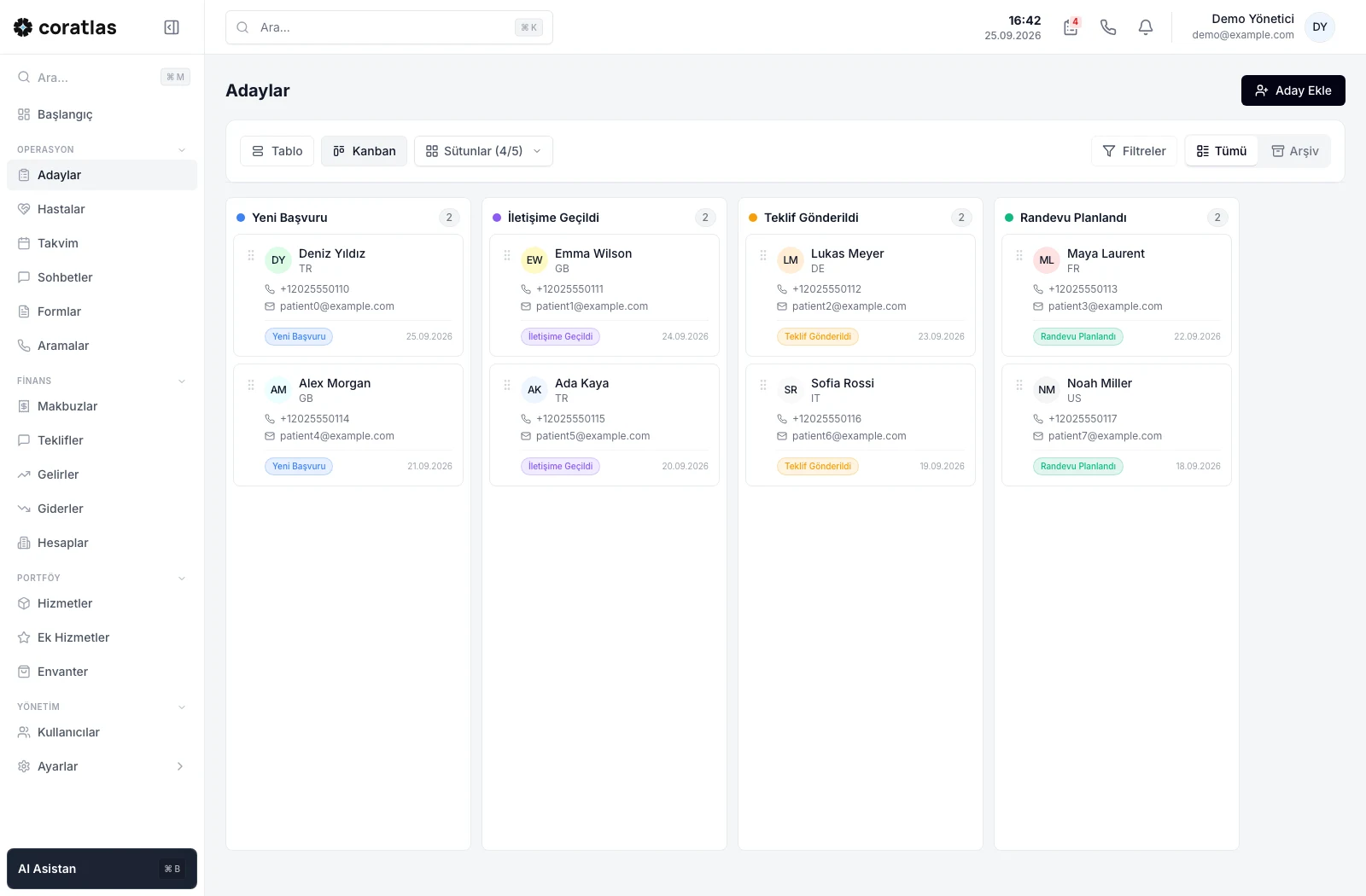
Coratlas Klinik automatically assigns enquiries from Facebook and Instagram forms to your agents. You track the process with a Kanban view and customisable statuses. WhatsApp messages, calls, appointments, forms and receipts all stay in the same record.
Multi-currency quotes and partial payments run from the same panel as well. To choose modules, read our clinic management software guide. You can also try the product free for 30 days.
Frequently asked questions
Can patient follow-up run on a spreadsheet?
It can for a while, in a small team with few enquiries. However, once you have several agents, languages and channels, records scatter. Keeping health data in a shared file also creates a security risk.
How many stages should the process have?
Five to seven stages suit most clinics. Choose few enough for the team to update daily, yet enough to reveal bottlenecks.
Is patient follow-up the same as a CRM?
No. Patient follow-up is the process itself, and a CRM is one of the tools that runs it. Clinic-focused software also adds appointment, form and payment modules.
What if the same patient enquires again?
Find and update the existing record instead of opening a new one. That way, past conversations and quotes stay together. So check for duplicates by phone number.
This article is for general information only and is not legal, financial or medical advice. Consult a qualified professional about your own situation.